Watch
What are innovation districts?
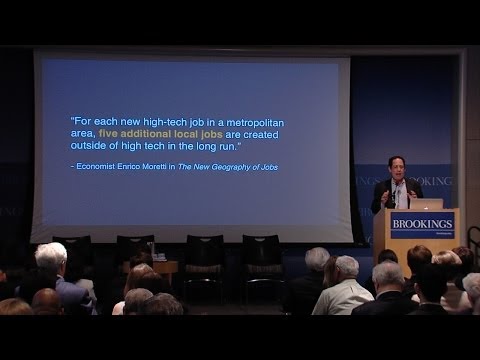 What Are Innovation Districts?
Video: “What Are Innovation Districts?” on YouTube. Embedded via youtube-nocookie; we verified it permits embedding before including it.
Homes, workspace and community on the same few acres — the live-work building fused with the innovation district, shrunk to human scale, with the one thing big districts leave out: affordable housing for the makers themselves.
An innovation village is a small, walkable place that puts homes, workspace and community in the same few acres, so that living and making are neighbors instead of a commute apart. It borrows two well-established ideas and fuses them: the live-work building and the innovation district.
Brookings defines innovation districts as “geographic areas where anchor institutions and companies cluster and connect with start-ups, business incubators and accelerators… physically compact, transit-accessible, and technically wired,” offering a mix of housing, office and retail (The Rise of Innovation Districts, Brookings, 2014). An innovation village shrinks that idea to human scale and adds the missing ingredient the big districts usually price out: affordable housing for the makers themselves.
A small, private, dignified home. Because the commons carry the heavy space, the home itself can be modest — even a single container footprint — and still feel like enough.
Shared workshops, a maker shop, coworking and a commercial kitchen a few steps from your door. You rent one place and get both a home and a place to build.
Front porches, an event lawn and a calendar of gatherings. Community is designed in, not left to chance — the way Tiny Hacker House has run events since 2010.
An innovation village is easy to mistake for things that already exist, so it helps to say what it is not. A coworking space rents you a desk but sends you home to an expensive apartment across town. An incubator gives you mentorship and maybe money, but not a roof. An apartment complex gives you a roof but no workshop, no commercial kitchen, no built-in collaborators, and rising rent. Each solves one slice of a maker’s problem and leaves the rest.
The village’s whole premise is that housing, workspace and community are one bundled offer at a price a beginning maker can actually pay. That bundling is the innovation — not any single amenity. When your home, your shop and your peers are the same short walk, three things get cheaper at once: your rent, your studio, and the cost of finding people to build with. Proximity is the product.
| What you get | Coworking | Incubator | Apartments | Innovation village |
|---|---|---|---|---|
| Affordable home | – | – | maybe | yes |
| Shared workshop / tools | desks only | sometimes | – | yes |
| Built-in community | some | cohort | – | yes |
| One rent covers it | – | – | – | yes |
Illustrative comparison of the live-work-village model against adjacent options. Details vary by operator.
What Are Innovation Districts?Video: “What Are Innovation Districts?” on YouTube. Embedded via youtube-nocookie; we verified it permits embedding before including it.
None of the pieces here are speculative. Each already exists somewhere:
Mobile Loaves & Fishes built a master-planned neighborhood of micro-homes and RVs clustered around shared kitchens, laundry, restrooms and gathering space. It houses hundreds of formerly homeless neighbors and is expanding by roughly 1,400 more homes (MLF; KXAN). It is living proof that small private homes plus generous commons can be humane at scale — the exact geometry we propose.
From research parks to reclaimed industrial waterfronts, cities have deliberately clustered makers, capital and space. The Brookings work above catalogs dozens. Our contribution is scale and price: a village, not a district, and one where the makers can afford to sleep inside it.
Adaptive-reuse container projects — from live-work commons to market-rate infill — have shown that steel boxes can become quick, characterful, lower-cost homes. We cover the real economics, and the real caveats, on the model.
The modern “live-work” unit began with artists occupying industrial space in places like SoHo; cities eventually zoned for it. We are simply making that arrangement affordable and intentional rather than accidental.
Innovation districts already work for institutions and capital. A village aims the same design at the person actually holding the soldering iron.
See the affordability case How we'd build it